
1990s
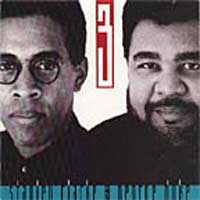 While this CD didn't have the vibe of our first record together, it was vastly superior to the second CD. There was a lot of raw energy coupled with orchestration finesse. That's what Clarke/Duke is about - sweet and sour!! The year was 1990.
In the end we probably should have stuck to our original idea of having the record built around our talents instead of diluting the music with so many other musical personalities. Well, they say hindsight is 20/20. This record, in sheer energy alone, really reminds me of our live performances though.
I won't go through the songs one by one, but let me mention that our drummer was Dennis Chambers, who is incredible!!
One deep change on this record was the presence of rappers on "No Place To Hide." On the same tune is a young Rahsaan Paterson. He was a teenager at this time, I think around 15 years old.
Another great moment on this CD is "Mothership Connection." I called all my buddies that were in town and told them to come on down to the studio and bring their thang wit um! Besides being funky, we had the opportunity of working with George Clinton on the video.
One of my favorite tunes is "Right By My Side," written by Stanley, with Gerald Alston singing the vocal. I love his passion and delivery. Now that's what singin' is all about!
"Lady" was another ballad in the style of "Sweet Baby." A real nice tune with one of my better vocal performances on record.
The interesting thing about "Find Out Who You Are," besides the subject matter, is the appearance of Joe Henderson on tenor sax and Wayne Shorter on Soprano Sax. Stanley and I spent many hours working on the environment for this tune, which were all samples patched together. We wanted the listener to be able to visualize themselves in this scenario right at the beginning of the song.
Stanley and I toured for awhile in the States and Europe, and I can tell you, this material got over very well, especially in Europe.
 After the Clarke/Duke 3 tours were finished, I delved headfirst into record production. I was really having a good time. I also began recording and touring with Anita Baker, and at that time she was so hot, that touring with her was like touring with nobody else. She also treated me like a King (not a Duke I might add) and was overall a wonderful touring partner. I did this for several years, until 1992.
The only reason I started making records again was because Mo Ostin wanted to sign me at Warners. He saw me at the Montreux Festival, doing a show with Rachelle Ferrell, in her first performance in Europe, and was so impressed with her that he signed me! Seriously though, we turned the festival out!!!! I was feeling real good about playing music again and was content to not have a record deal unless I could have the freedom to make unorthodox records as well as commercial ones. He agreed to allow me to make different kinds of records that were geared towards different audiences. In fact, when we had our first meeting, I told him I wanted to make an acoustic jazz record just to test his starch. He told me to make whatever kind of records I wanted to. I then told him I was just joking, but did eventually want to make an acoustic jazz record. I was, and still am, committed to expand into other musical areas.
This is a great record. Probably because it has a focus and I was really relaxed when I cut it. I was not trying to reach a certain radio market or write a hit record. I was just making music that I loved. It was important that this record represent me honestly, and I think that honesty is why this record was so successful.
Of course, it didn't hurt to have a hit. "No Rhyme, No Reason" became a kind of anthem for suppressed feelings. I can't tell you how many men and women tell me how much this song means to them. It means a lot to me as well. This record put me back on the map. The biggest mistake was not making a video. But at first, no one except Hank Spann at Warners thought we had a big record. I never will forget his excitement after his first listen. I was shocked. I didn't want the song to be the first single because I didn't want people to think that this was another vocal record. It was important to have the integrity of my instrumental playing shine through. But I can't deny that he made the right choice.
I remember when Rachelle Ferrell sang the end of the song. I told her not to sing any words - just moan. In one take she simply floored me! I would not let her change it. When it's right, it's right!!
There is much I could say about the making of this record, but that will have to wait for my book. However several highlights for me would be "Fame" with some of my favorite heroes on vocals. Also on "Geneva" was my old buddy Hubert Laws on flute. Nobody plays like him. Hubert, I love ya man! George Howard makes a nice appearance on "The Morning After."
George Howard makes what turned out to be one of his final performances on "The Morning After."
I must also mention the incredible sensitive playing of guitarist Ray Fuller on “No Rhyme” – I mean, can anybody play it better? It’s like he was in my mind! My constant cohort Paul Jackson also made some prominent musical statements on this album.
I should also mention that this is the first record I made with Larry Kimpel on bass. I met him through Anita Baker, and he is not only a fabulous player, but a fabulous person as well.
This record is closer in content and vibe to the records I made as a young recording artist. I won't say anymore, except that this one is really me, and means a lot in my overall career and scheme of things. I'll let you discover the rest.
 This was the hardest thing I've ever done. To think of the amount of music I had to write and orchestrate still gives me a headache.This record is the first in a series of concept records for Warners, which puts in motion the more unorthodox recordings I spoke to Mo Ostin about before I signed with Warners. Matt Pierson, who took over for Mo, at least as far as I am concerned, has taken the same stance. I really appreciate his dedication, honesty, love and support for the music.
This recording came about as the result of a party at Quincy Jones home. I had three movements in my sequencer. My manager had spoken to Claude Nobs, of the Montreux Festival, about doing a jazz/orchestral evening featuring this piece.
Quincy Jones was having a birthday party for Claude, so I went to celebrate his birthday and give him the tape to listen to at his leisure. Well, Quincy put it on without my knowledge, and it got very quiet at the party as everyone started to listen intently. After the first movement, Claude and Quincy raved that we had to do this at the Festival that year.
So, they commissioned me to finish the piece and debut it at the Festival. Matt agreed to release it on Warners. It was really tough dealing with an orchestra that was partially hostile. I won't go into detail because I am very happy to have the Suite documented on CD. However, many, many hours went into fixing these tracks, which should not have happened with musicians of that caliber. I have since performed it with other orchestras with an amazing result.
The featured musicians are Stanley Clarke on bass, Chester Thompson on drums, and Paulinho Da Costa on percussion.
Each phase, or movement, represents a different aspect of what Muir Woods means to me. I used to camp there as a young boy, and I remember being frightened and in awe of the giant trees and foliage - the sounds - the smells. I tried to bring all this to the Suite.
I desired to write music that developed a true symbiotic relationship between orchestra and small jazz band. Though they begin playing separately, they are totally intertwined by the end of the piece. I even have a swing section for the orchestra, and as you musicians know, that is a tall order; but I didn't want my writing to be hampered by the limitations of some men's minds, and the fear of challenging stale attitudes.
Serious black orchestral writers don't often have the opportunity to have their works performed, so I realize I am blessed to have this chance. Though I don't do this for a living, the challenge along with its rewards make the whole thing worthwhile. Besides, I've always liked breaking down barriers.
The year is 1993, but we held the release until my next CD, Illusions, had run its' course.
 I don't know if I should say this again, but I like this CD. It was made to follow Snapshot, even with a follow up single to "No Rhyme, No Reason, called "Love Can Be So Cold." I like to call this album Snapshots' sister. It's 1995.
I kept the instrumental nature of the record strong. The first single "Love Can Be So Cold," while not doing as well as its predecessor, did garner a lot of radio play; and "Simple Things," to my surprise, became a Smooth Jazz Radio hit.
I put another one of those tunes with a lot of singers called "Life And Times." This one rocks! It has a little more of a gospel feel than the other ones, with a slammin' bass solo by Larry Kimpel. Featured is Rachelle Ferrell, James Ingram, Joyce Kennedy, Mervin Warren, Marvin Winans, The Emotions, Lori Perry, and Everette Harp.
I decided to write a tribute to the past on "Buffalo Soldiers." It's a kind of jazz - funk extravaganza with a narrative.
My cousin Dianne Reeves blesses us all with her voice on "So I'll Pretend." I love her so much!! She is a true talent that brings tears of joy to my eyes when I hear her sing. Also featured on this tune are Kirk Whalum on tenor sax, Ray Brown on bass, and Terri Lynn Carrington on drums. A great band!
Ray Fuller plays guitar on all but one track. This album really demonstrates the gift that he has to “play the spaces.” Ray doesn’t play a lot of notes, he instinctively feels where he should and should not play, putting just the right “thang” where it needs to be. He’s a brilliant listener! (more musicians should take heed).
 This album is quite musically diverse. There are some great moments, but in the end they don't hold the album together as a focused album. But the great moments are great I must say. The funk material is real funky, and the pretty tunes are real pretty. For some reason, at that time, I felt I needed to let it all out, you know, show my diversity again.
The lyrics overall, are meant to make one think. From "Is Love Enough" to "Whatever Happened To---," and "Love Songs" which I believe was the last recorded performance of my good friend George Howard, who I miss dearly.
I had been touring with Rachelle for some years by this time, and we had begun using a young drummer from Atlanta, John Roberts (Janet Jackson). This record also features Ndugu on drums and Byron Miller on bass - what else is new?
One personal highlight is "This Place Called Home" which features a duet with Dianne Reeves and Jonathan Butler. I love "Whatever Happened To---" with my buddy Dori Caymmi.
"Back In The Day" features some of my jazz buddies. On trumpet, Oscar Brashear; on percussion, Airto; on sax, Benny Maupin, and on trombone, Bruce Fowler.
"Kinda Low" and "Is Love Enough" was recorded like I used to record my old funk records. I think it was the first time Rachelle Ferrell had been exposed, one on one, to that kind of environment. She blossomed like a flower, and being a natural music explorer and seeker, decided she needed to put some more funk in her life. Oh lord, what have I done? Well, if it's in ya it's gonna come out - or your nose will grow!!
"How About You" features Norman Brown on guitar, a recent signed artist to Warner Brothers. He's a great young player.
I wrote the theme song for the Malcolm and Eddy show, along with its stars. It was such fun, that I decided to finish the song and put it on my CD. The song features Vesta and Lory Perry. Also featured are Gerald Albright on sax, Ray Brown on trumpet (Earth, Wind & Fire). 1997 is the year, and my old buddy Paul Jackson on guitar. I must also mention once again the brilliant playing of Ray Fuller - 1997 is the year.
 This is the second of my concept records. Matt Pierson asked me to write a wish list of projects I'd like to record. An After Hours record was at the top of the list.
It was completed very quickly, all in first or second takes. It's the easiest record I've done in years. There was absolutely no pressure. Music was the only thing that mattered, not some artificial outside pressure to perform or be understood.
Ndugu played drums on all takes. I used several bass players including Christian McBride, upright bass; Karry Kimpel, electric and fretless bass; Byron Miller, electric bass; and Lenny Castro, percussion. Paul Jackson and Ray “the weeper” Fuller round out the rhythm section as only they can.
Basically this record is "a night in the life of" type record. It begins when one leaves work with the hustle and bustle of rush hour traffic. But upon arriving at home, the vibe of the record changes to one of coolin' out. From there, we are taken on a journey through the evening, which includes one's significant other.
This is a keyboard CD. There are no vocals. I wanted the piano to be the main instrument with various electric pianos and synths used for variation and vibe. It is a melodic CD - not a lot of riff raff or playing fast to show how many notes can be played in a bar; but rather the simple statement of melodies and feelings. After all, that is the way of the hours after.
1960s | 1970s | 1980s | 1990s | 2000s